Blackpool

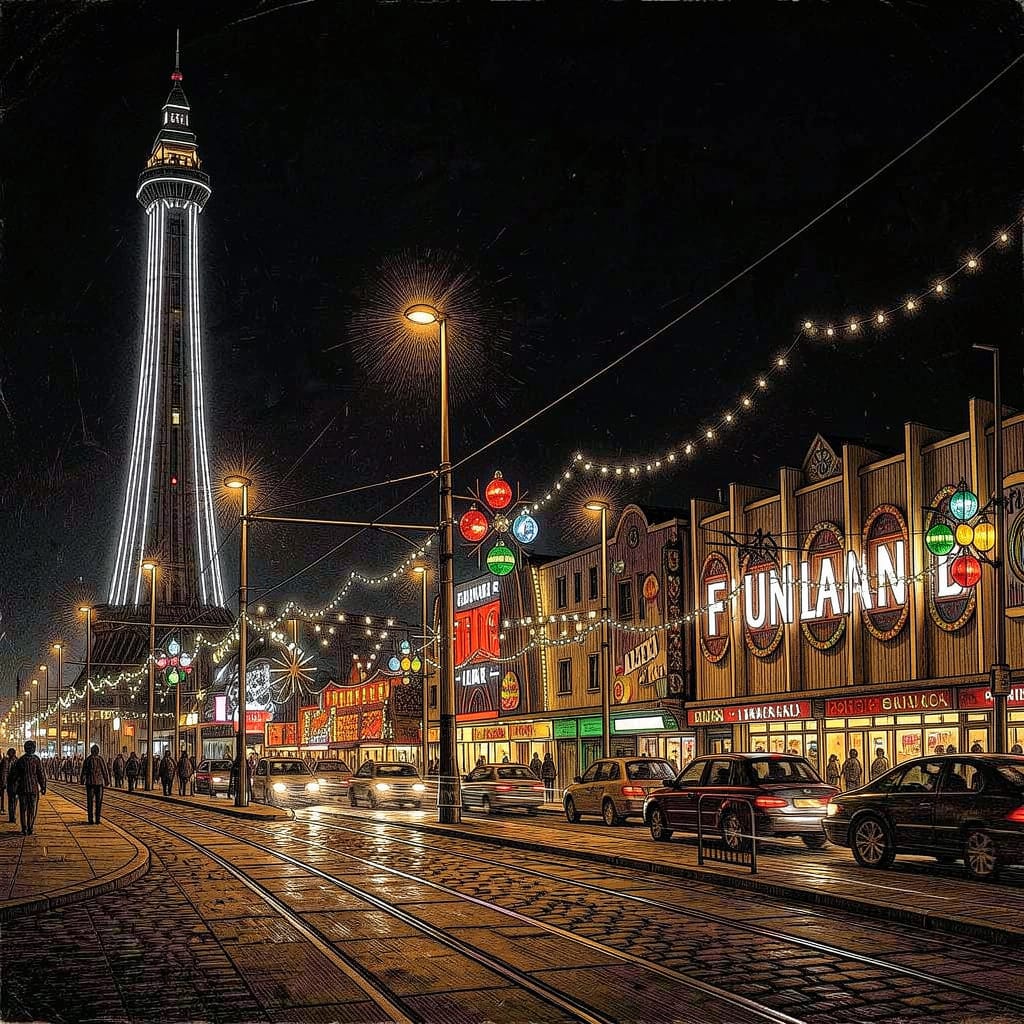
Blackpool Tower and the Golden Mile, Lancashire

Location Profile
Type Seaside resort town
County Lancashire (unitary authority)
Coast Fylde Coast, Irish Sea
Notable Landmark Blackpool Tower (1894)
Notable Feature Blackpool Pleasure Beach, home of the Big One (1994)
First Appearance Cambion, Chapter Twenty-Two: Exits and Entrances

Blackpool

Working-class seaside resort on the Fylde Coast, Lancashire.


Overview

Blackpool is a seaside resort town on the Fylde Coast of Lancashire, facing the Irish Sea. For much of the nineteenth and twentieth centuries it was England's pre-eminent working-class holiday destination, built almost entirely on the seasonal migration of industrial Lancashire and Yorkshire out of the mill towns and onto its beach. It remains defined by three structures raised in a single Victorian burst of ambition: three piers, a tower modelled on one in Paris, and, later, one of the largest amusement parks in the country.

The town's character is loud, bright and unapologetically commercial — arcades, fish and chips, novelty shops, the sea a backdrop rather than the point — a texture built up over more than a century of catering to visitors who had saved all year for a single week away.


Geography & Atmosphere

Blackpool sits on a low, flat coastal strip with almost nothing between the promenade and the open sea; the wind off the Irish Sea is a near-constant presence, and the town's appeal has always leaned into weather rather than away from it — wet or fine, there is somewhere indoors to spend money. The Golden Mile, the stretch of central promenade between the North and South piers, concentrates the amusements, arcades and novelty shopfronts that give the town its reputation; by night, under the Illuminations, the same stretch becomes something closer to a five-mile funfair.

Running the length of the seafront, from Starr Gate in the south to Fleetwood in the north, is the Blackpool Tramway — Britain's first electric street tramway, opened in 1885, and the only first-generation tramway in the country never to have closed. Its heritage double-deck cars, kept running alongside the modern fleet, are as much a part of the seafront's texture as the piers or the Tower itself, and during the Illuminations become part of the display in their own right, decorated and lit for the length of the run.

History

Blackpool's transformation from a small coastal village into the country's largest resort followed directly from the railway's arrival in 1846, which put the Lancashire coast within reach of the cotton towns for the first time. Growth was driven by Wakes Weeks: the practice, unique to the industrial North, of mill owners closing their factories for a single week each year for machinery maintenance, with each town taking a different week so that Blackpool could count on a rolling supply of visitors across the whole summer. Workers travelled first by charabanc, then increasingly by train, in numbers that reshaped the town completely; by the 1890s its population had passed 35,000, and it could accommodate a quarter of a million visitors at once.

Three piers were built to service the trade — North Pier in 1863, Central Pier in 1868, South Pier in 1893 — making Blackpool the only English town with three. In 1879 it became the first municipality in the world to install electric street lighting along its promenade, a novelty that within a generation had become the Blackpool Illuminations, switched on every autumn since to draw visitors into the off-season. The Winter Gardens complex opened in 1878, and the town's single most recognisable structure — the Tower — in 1894.


The Tower & the Pleasure Beach

Blackpool Tower, opened in 1894, was explicitly modelled on the Eiffel Tower, though at 518 feet it stands considerably shorter than its Parisian inspiration. It remains the town's defining landmark, visible from almost every point on the seafront, and houses a circus, a ballroom and an observation deck within its structure.

Blackpool Pleasure Beach, founded in 1896 at the southern end of the promenade, is one of the most-visited amusement parks in the country. Its best-known ride, the Big One, opened in 1994 as the tallest and fastest roller coaster in the world at the time — a title it has since lost, though its steel frame, strung with running lights, remains visible for miles along the coast after dark.


Decline & Regeneration

Blackpool's Victorian and Edwardian boom did not last indefinitely. From the 1960s onward, cheap package flights to reliably sunny Mediterranean resorts drew away the working-class holidaymakers who had once filled the town for a full week at a time; visitor numbers and overnight stays fell steadily for decades, and the guesthouses built to accommodate them were gradually converted into cheaper, harder-to-maintain multi-occupancy housing. By the twenty-first century Blackpool was consistently ranked among the most deprived towns in England, a reputation that has sat uneasily alongside its continuing identity as a byword for British seaside fun.

More recent years have brought sustained regeneration investment — a rebuilt promenade, a refurbished Tower, and new rides at the Pleasure Beach — aimed at drawing back longer stays rather than the day-trip and stag-and-hen traffic that increasingly define the town's modern visitor economy. By 1997, the year of the saga's own visit to the town, that decline was already well under way, if not yet as severe as it would later become.


Role in the Saga — Cambion spoilers Covers the first of three deliberate day trips in Chapter Twenty-Two.

Blackpool is the first of three trips Toby Knight engineers in Chapter Twenty-Two: Exits and Entrances, three days after a car-park conversation in which Declan Marsden had suggested, carefully, that a change of scenery can help. Toby reads it for what it is — an exit strategy dressed as concern — and turns it into a plan of his own: the well-dressing, the fête and the carnival are the three weekends the village will “pull itself open like a stage set”, and rather than let that happen with Robert at home, he proposes three trips to match: Blackpool first, Alton Towers after, and Twycross in July, if they can manage it. Ben agrees reluctantly — “We're not doing the rides” — and checks the train times without being asked.

They travel up by train via Manchester, Toby buying Robert a copy of Match magazine for the journey. Arriving on “a breath of salt and burning oil,” Robert spots the Tower first; Ben asks who built it, and Toby supplies the answer — Victorians, modelled on the Eiffel Tower — that this page's own History section repeats as simple fact. Their B&B looks out over the funfair; from the twin room's window, Robert can see the Big One's steel frame “stitched with red bulbs” before they have even unpacked.

The afternoon is spent in the arcades along the front — Tekken 2, Daytona USA, and Street Fighter II cabinets “that had been earning their keep since before Robert started school,” a row of Time Crisis machines standing dark and idle, too early in the day for the serious players. Toby wins a small avalanche of tokens on the pushers; Ben warns Robert off the claw machine as rigged, and is proven right — Robert loses every coin he has to it, the prize always falling just short, as though the machine had been taught exactly where to stop. At the machine beside his, a girl — black hair in soft waves, a four-leaf-clover charm at her throat — plucks prize after prize with what the text calls eerie precision, and, watching him fail, simply bends and presses one of her own winnings into his hand without being asked: “Better luck next time.”

For tea they eat chips under a bus shelter in the rain, a hen party tottering past on the far pavement; at the fairground, Robert declines the ghost train and every ride that follows, circling their edges instead and watching the crowd rather than the machines. On the carousel he rides alone while Toby climbs the horse beside him and Ben stands at the post behind them, not riding, simply anchoring the moment the way he anchors most moments.

That night, watching the Big One from the B&B window, Robert sees every one of its lights go out at once for a full second, then return exactly as before. He waits for it to happen again. It doesn't. He tells himself it was a power dip. The text does not resolve the moment either way — it sits in the same register as the small unexplained things the saga scatters throughout its quieter chapters, felt rather than confirmed. The day ends as most of theirs do: Toby reading aloud from Robert's book — a story, this time, of a knight, a dragon and a kingdom built on sand — a ritual Robert notices happens every single night, without once asking why.


Trivia

  • Blackpool was the first municipality in the world to install electric street lighting, in 1879 — the same innovation that, within a generation, became the Illuminations that still define its autumn season.
  • Blackpool remains the only English seaside town to have kept three separate piers, a legacy of the sheer volume of Wakes Weeks trade the resort once handled at its Victorian peak.
  • The Street Fighter II cabinets in the seafront arcades are the same game Robert and Daniel play together at the Stockport Arcade — an unremarked echo between two otherwise unconnected scenes.

Appearances

Title Role Notes
Cambion
Book One · Book of Thoth Saga
Day-trip setting The first of three deliberate excursions in Chapter Twenty-Two: Exits and Entrances, covering a full day and night in the town.